A useful credentialing status report tells you what has been completed, what is blocking progress, who owns the next action and what evidence supports each status. It should distinguish credentialing review from contracting, enrollment and confirmed participation for the relevant practice and location.
A percentage-complete figure cannot answer whether a particular clinician is ready for a particular payer's patients. Build the report around the decisions scheduling, billing and management actually need to make.
Bring a sample report with sensitive details removed and the questions it fails to answer. PPS can discuss your reporting needs and the credentialing support available for your practice.

What should each row represent?
Use a separate record when the payer, product, provider, billing entity or location requires a distinct participation decision. Grouping several products beneath one insurer's name can hide an unresolved item.
A practical report includes:
- Provider and practice: identifiers, including the relevant tax ID or billing entity, limited to what each reader is authorized to see.
- Participation scope: the payer, product and location covered by the request.
- Current stage: what has happened and the date that status was last confirmed.
- Evidence: the submission or case reference and supporting correspondence.
- Next action: the outstanding item, accountable owner and next follow-up date.
- Effective date: the confirmed date and scope, or an explicit unresolved status.
This is a recommended reporting structure, not a universal payer form or a claim that every software product uses these fields.
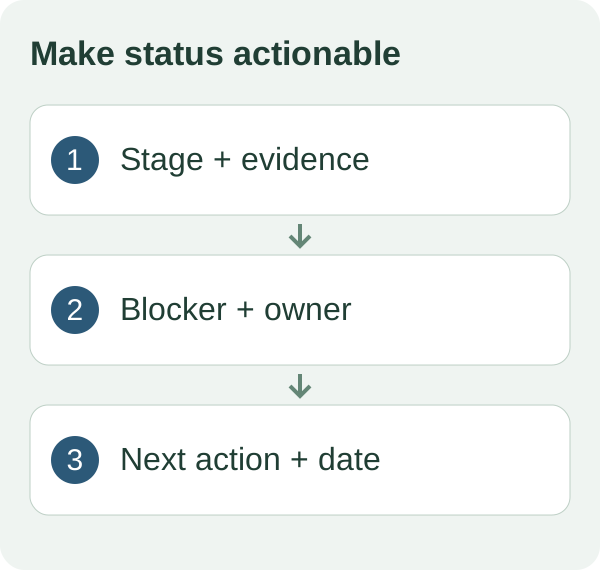
Replace vague statuses with a next action
“Pending” is useful only when the report explains pending with whom and for what. “Awaiting provider signature; onboarding coordinator to request it by Friday” supports action. “In process” does not.
Similarly, distinguish an application submitted from an application received. Preserve the confirmation where available. If the payer requests another document, link the request to an owner rather than leaving it buried in a general notes field.
UnitedHealthcare's public onboarding page illustrates why separate stages matter: credentialing and contracting are distinct parts of its workflow. Other payers and delegated arrangements can differ, so the report should reflect the actual process being used.
What evidence should support “complete”?
Ask what the label means. It may refer to a document packet, credentialing review or a different milestone. Record the underlying confirmation and any limitations rather than treating every completed task as permission to schedule in-network care.
A hypothetical example: the credential review is complete, but the practice is still waiting for a contract amendment for a new office. The report should show both facts. It should not turn the whole provider row green and leave the location issue for billing to discover later.
Before the scheduling handoff, confirm the applicable payer agreement, provider-to-practice linkage, covered service location and effective date. Credentialing approval alone does not establish all of those conditions or guarantee claim payment.
Where does Metolius Health fit?
Metolius Health describes credentialing and enrollment as part of its operations offering. When discussing service with the team, ask to see how reporting will work for your providers, entities and payers. Confirm who updates the information, where supporting records live and how your practice receives urgent exceptions.
Treat those as buying questions. Confirm any dashboard field, automated alert, update interval or service commitment in the demonstration and written scope for your practice.
Use the report in a short exception review
Focus the meeting on records that need a decision. Identify missing signatures, unanswered requests, unexpected delays and upcoming starts without confirmed participation. For each exception, agree on one next action and a date to check it.
Keep a dated record of what scheduling and billing were told. When the status changes, update the handoff as well as the report. A report that is accurate but never reaches the people making appointments still leaves a gap.
Ask for a report you can use
We can discuss the providers, payer relationships and internal handoffs your team needs to track. Bring the questions your current report leaves unanswered.
Start with the checklist if your first priority is getting the underlying records organized.